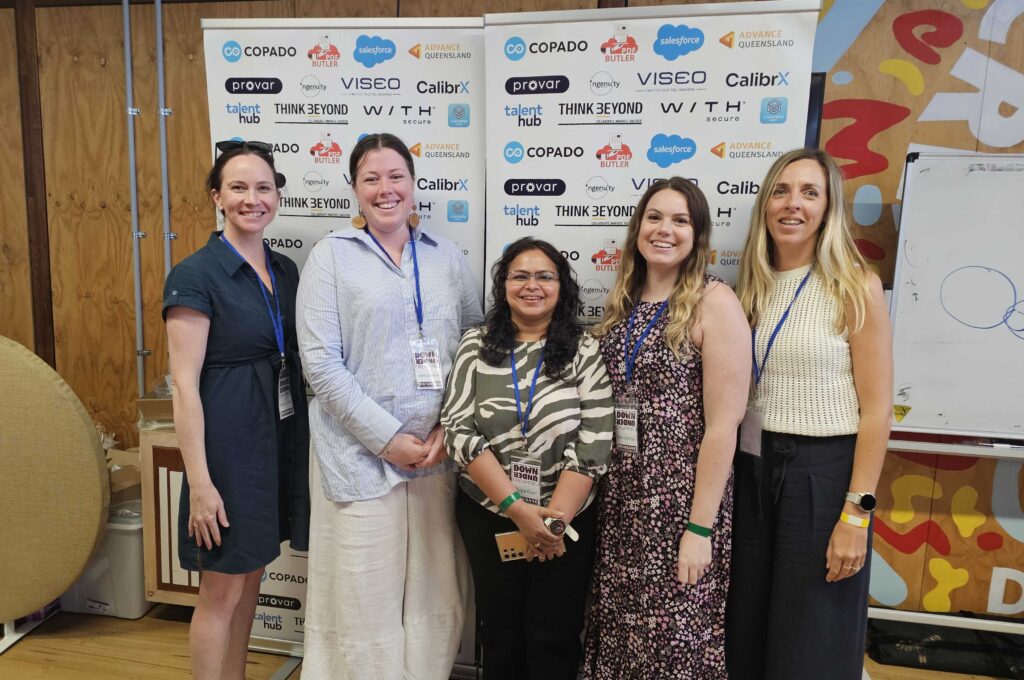
Down Under Dreaming Brisbane 2025 was packed with great sessions this year, and I walked away with dozens of slide photos and more than a few “I need to try that” moments. While every speaker brought something valuable to the table, three talks in particular felt especially relevant for the organisations we work with. They were practical, thoughtful, and full of insights worth passing on - so I’ve pulled together a quick wrap-up of the key takeaways.
Beyond the Hype: Practical Strategies for AI, Integration & Automation in Your Organisation
Jannis’ session was a grounded, technical look at the reality of AI in modern organisations.
Key Takeaways
1. AI Is Most Powerful When It Automates High-Volume Micro-Tasks
Through a hands-on demonstration using a voice bot built with ElevenLabs and Salesforce Experience Cloud, Jannis showed how an AI agent can:
Collect customer information conversationally
Pull technical specs from PDFs dynamically
Create leads via API using an MCP server
Trigger downstream automations (e.g., Slack bot that creates a channel, posts summaries, create canvases)
This is the emerging pattern of AI adoption: automation of the “micro-tasks” that drain time at scale, rather than grand, all-encompassing workflows.
2. Good Architecture Is What Makes AI Actually Useful
Architecture Matters More Than the AI Itself
Jannis's demo was powerful - but also complex under the hood. He emphasised that:
AI agents don’t run in isolation; they run inside a system architecture.
Real-world deployments quickly become complicated because multiple systems, APIs, and agents must coordinate.
Organisations need architectural guardrails early, or they risk creating an unmaintainable tangle of agents, workflows, and integrations.
His message: AI is not a magic switch. Good architecture is the difference between a useful agent and a chaotic one.
3. Use the Right Integration Pattern
Two emerging standards were particularly important:
Model Context Protocol (MCP)
Allows you to expose existing APIs to AI agents as “skills”.
Critical when a system doesn’t support native agentic frameworks.
Agent-to-Agent Protocols (A2A)
Enable multi-agent collaboration across platforms (e.g., Salesforce Agentforce calling SAP agents).
Support capability discovery, delegation, and coordinated workflow execution.
These protocols are becoming the modern equivalent of MuleSoft connectors in the integration world.
4. Governance, Testing, Guardrails, and Monitoring Are Essential
Even sophisticated platforms can behave unpredictably. Without proper testing and guardrails, agentic systems risk becoming opaque or brittle. Organisations need clear governance, visibility, and error-handling from day one.
For large organisations, Jannis argued for:
A centralised orchestration layer
Clear logging and monitoring across all agents
A governance model for platform-specific agentic frameworks
Without this, organisations will quickly lose visibility into what their agents are doing and how decisions are being made.
Quality at Every Step – Testing Across the Application Lifecycle
Marcelo’s session was a refreshingly honest discussion about testing discipline in Salesforce environments. His overarching point: developers are responsible for their own quality.
Key Takeaways
1. AI-Generated Test Classes Create a False Sense of Security
Marcelo cautioned that:
AI can produce syntactically correct test classes that achieve code coverage
BUT they rarely test the right scenarios (positive, negative, and edge cases)
Teams risk thinking they are “covered” when they are not
His strong advice: AI can help, but human-designed test strategies are essential.
2. Choose the Right Test Execution Strategy for Your Pipeline
Different Salesforce environments behave differently, and running all tests every time can cripple deployment throughput.
He compared deployment speeds:
Running all tests: hours
Selected tests: minutes
Sibling test class strategy (matching each Apex class with a test class): 5–10 minutes per deployment
A smart pipeline:
Runs targeted tests for individual deployments
Runs all tests periodically (e.g., nightly) for safety
Automates selection using static code analysis
3. Key Testing Principles That Really Matter
Marcelo emphasised a handful of non-negotiables:
Never run tests as System Administrator – test as a real user
Always use proper assertions
Design multiple test methods covering meaningful scenarios
Avoid running tests with “SeeAllData=true” except when required
Test bulk operations with at least 200 records
Avoid monolithic test classes and unmanaged flow complexity
His message: Quality doesn’t cost time - poor quality does.
Tech Meets Heart: Understanding the Community Sector’s Unique Tech Challenges
Brentyn’s session was a refreshingly candid look at the realities nonprofits face: rising costs, capped funding, increasing compliance requirements, and the pressure to do more with less. For those of us who work closely with nonprofits, his perspective reinforced a lot of what we see day to day.
Key Takeaways
1. Efficiency Doesn't Equal More Revenue in the Nonprofit World
This was the most important message of the session.
Unlike commercial businesses:
Greater efficiency does not generate more revenue.
Funding is often fixed, grant-based, and capped.
Savings don’t flow back into the organisation - they simply reduce pressure.
So when vendors sell “efficiency dividends”, they miss the mark.
What nonprofits do need is effectiveness - technology that helps staff deliver impact with the limited time and resources they have.
2. Costs Are Rising Faster Than Funding
Sector-wide trends include:
Revenue up 5.6%
Expenses up 12.6%
Wages up 10%+
Nonprofits are being asked to do more with less, while compliance requirements increase.
This makes technology a strategic necessity, not a luxury.
3. Nonprofits Need Strategic Partners, Not Order Takers
Brentyn highlighted that many nonprofits have experienced fragmented or overly customised implementations in the past. For partners like us, his message reinforces the importance of:
designing for long-term sustainability
keeping the solution lightweight and scalable
being transparent about trade-offs
guiding organisations to what they need, not just what they ask for
It’s absolutely possible to deliver incredible outcomes for nonprofits - but it takes empathy, clarity, and a focus on their long-term operational reality.
If you are looking for a strategic partner with expertise in turning complexity into clarity, contact us.
Summary Turning the Zendesk Sell Retirement Into an Opportunity The announcement is official: Zendesk Sell is retiring. Many businesses rightly worry about potential downtime, pipeline disruptions, and a complex migration process. However, finding a Zendesk Sell alternative shouldn't just be about finding a like-for-like replacement with the exact same limitations you currently have. Instead, this […]
It’s that time again - Summer has bloomed for our northern hemisphere neighbours, and so have the latest Salesforce updates! We’ve dug through the Summer ‘26 release notes and handpicked the most exciting features for business users and admins. Check out our latest blog, where we break down the highlights and what they mean for […]
The Salesforce Summer ‘26 release is here, and it's a significant one! There is a strong focus on AI-powered automation, enhanced service capabilities, deeper Slack integration, and platform security improvements, all aimed at improving how organisations build, manage, and secure their Salesforce environments. Depending on your instance, you'll be upgraded on one of the following […]
In the spirit of reconciliation Enrite Solutions acknowledges the Traditional Custodians of Country throughout Australia and their connections to land, sea and community. We pay our respect to their Elders past and present and extend that respect to all Aboriginal and Torres Strait Islander peoples today.